

Credits
16
Prerequisites
None
Dates
Jan 28 – May 12
Program Countries
Australia, Japan, Taiwan
Program Base
Sydney, Tokyo, Taipei
Visa
Varies
Critical Global Issue of Study
Geopolitics & Power




Study across Australia, Japan, and Taiwan to dive into how three democratic societies navigate one of the world's most dynamic and consequential regions.

16
None
Jan 28 – May 12
Australia, Japan, Taiwan
Sydney, Tokyo, Taipei
Varies
Geopolitics & Power
Coming spring 2028!
Through a comparative approach, you’ll explore regional security, technological innovation, and economic competition while gaining insight into the forces directly shaping the Indo-Pacific and by extension the global order.
Learning extends beyond the classroom through site visits, expert engagement, and immersive field experiences that connect academic study with contemporary realities. The program culminates in an applied strategy course where students tackle international challenges through collaborative simulations and decision-making exercises.
Explore the critical issues defining the future of the region, including maritime security and alliances, digital infrastructure and cybersecurity, artificial intelligence and innovation ecosystems, and global supply chains, trade, and economic competition. By comparing the perspectives of a middle power, a longstanding U.S. ally, and a frontline democracy, you’ll gain a deeper understanding of the diverse strategies nations use to respond to regional challenges.
This program develops the analytical, cross-cultural, and strategic thinking skills needed to understand an increasingly interconnected world. It is designed for students interested in international relations, foreign service, political science, security studies, economics, business, Asian studies, political journalism, and technology.
Receive up to $1,000 in flight credits when you join this new program! Learn more HERE
None.
Students studying on this SIT semester-length program can choose to simultaneously complete a minor, with no additional coursework or cost. At SIT, a minor is a minimum of 16 credits taken within a content area. This standout credential can help boost your future job or graduate school applications.
SIT’s IHP Asia: Pacific Rim Politics and Power offers the opportunity to earn a minor in international relations or Asia-Pacific studies.
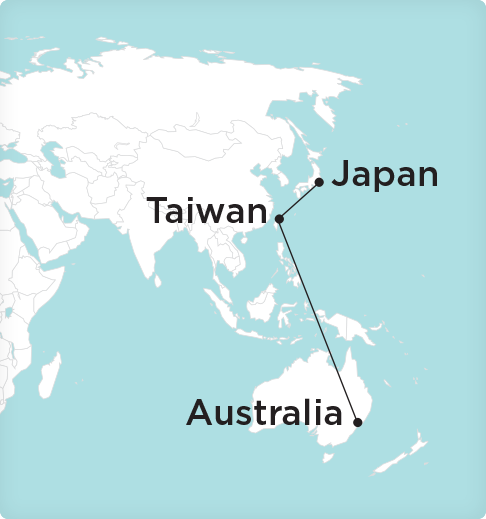


Based in Sydney, you will examine Australia’s role as a leading Indo-Pacific middle power balancing alliance commitments, technological collaboration, and economic integration across the region. Coursework and field-based learning explore how democratic states navigate security partnerships, innovation, and regional engagement while responding to an increasingly complex strategic environment.
In Tokyo, you will explore Japan’s position as a major democratic economy, technological leader, and cornerstone of regional security architecture. Through comparative coursework and experiential learning, examine evolving defense policy, technological innovation, and economic strategy while considering how democratic institutions adapt to shifting geopolitical realities.
Studying in Taipei provides you with a unique opportunity to examine democratic resilience, technological leadership, and economic interdependence in one of the Indo-Pacific’s most strategically significant societies. Field-based learning explores Taiwan’s globally important semiconductor industry, digital innovation ecosystem, and the ways democratic institutions respond to sustained regional pressure and rapid technological change.
Please note that SIT will make every effort to maintain its programs as described. To respond to emergent situations, however, SIT may have to change or cancel programs.
Upon successful completion of the program, students will be able to:
The following syllabi are representative of this program. Because courses develop and change over time to take advantage of dynamic learning opportunities, actual course content will vary from term to term.
The syllabi can be useful for students, faculty, and study abroad offices in assessing credit transfer. Read more about credit transfer.


Geopolitics of the Indo-Pacific
(4 credits)
This course introduces key concepts and theories of geopolitics, applying them to the evolving strategic landscape of the Indo-Pacific. Students examine the roles of major powers, regional organizations, and small-state diplomacy in shaping maritime security, trade corridors, and technological competition. Case studies focus on flashpoints such as the South and East China Seas, the Taiwan Strait, and U.S. alliance systems, as well as the rise of multilateral initiatives like AUKUS and the Quad. By combining spatial analysis with political and historical perspectives, you will develop a comprehensive understanding of how geography, power, and policy intersect in the Pacific region.
Digital Power in the Indo-Pacific
(4 credits)
This course examines how digital systems shape power, vulnerability, and strategic leverage across the Indo-Pacific. Focusing on Australia, Japan, and Taiwan, we will analyze digital infrastructure, cyber operations, innovation ecosystems, and governance regimes as interconnected dimensions of regional order. The course treats innovation not simply as industrial competitiveness, but as the architecture of digital systems that generate authority, dependency, and systemic exposure. It examines persistent cyber pressure from regional actors, including China and North Korea, as structural conditions shaping institutional design, alliance coordination, and digital resilience. The course emphasizes interpretation, judgment, and applied analysis rather than technical mastery, enabling you to assess how digital systems translate into geopolitical influence and strategic risk. Through comparative analysis and structured learning on location, we will evaluate how technologically advanced democracies manage interdependence, regulate digital domains, and respond to sustained strategic pressure.
Economic Power in the Indo-Pacific
(4 credits)
This course examines how economic interdependence, strategic industry, and trade governance shape power and vulnerability across the Indo-Pacific. Drawing from political economy and international relations, the course explores how states use markets, institutions, and economic leverage to pursue security and strategic objectives under conditions of constraint. Through comparative study of Australia, Japan, and Taiwan, we will analyze how advanced economies navigate trade dependence, supply-chain risk, economic coercion, and rulemaking in an era of intensifying geopolitical competition. The course emphasizes interpretation, judgment, and applied analysis rather than technical economic modeling, enabling students to assess how economic strategies function as instruments of state power.
Applied Geopolitics: Strategy and Decision-Making in the Pacific Rim
(4 credits)
This course serves as the applied, integrative component of Indo-Pacific Politics and Power program. It does not introduce new substantive material; instead, it provides a structured environment in which to apply, integrate, and stress-test concepts developed in companion courses on geopolitics, digital power, and economic statecraft. Working in interdisciplinary teams, you will represent one state and assume complementary expert roles in geopolitics, economics, and technology. Across Australia, Japan, and Taiwan, teams use knowledge gained from the program to formulate strategy, manage trade-offs, and make decisions under conditions of uncertainty, alliance constraint, and escalation risk. Through collaborative strategy development, live simulation, and guided reflection, the course emphasizes judgment, adaptation, and comparative reasoning, mirroring real-world policy environments in which decision-makers act on behalf of one state while relying on deep analysis of others. You will gain practical experience in how strategic decisions are formed, contested, and constrained in the contemporary Indo-Pacific.


Student accommodation includes a mix of homestays, hostels, guesthouses, and small hotels/dorms. Students will experience homestays and will be oriented as they move from place to place.

Potential career paths include:
Diplomacy and foreign affairs
Geopolitical risk and strategic analysis
National security and intelligence
Public policy and government
Technology policy and digital governance
International business and global strategy
International development and nonprofit leadership
Global trade and economic policy
Graduate study in international affairs, law, or public policy


SIT Study Abroad is committed to ensuring that international education is within reach for all students. We believe in the transformative power of immersive, intercultural experiences and are dedicated to supporting students in their educational journey.
See All Costs
Depending on your passport of origin, you may need a visa for this program. Please contact your admissions officer for more information.