Overview
Why study abroad in South Africa?
This program offers an opportunity to learn non-western perspectives in the fields of South-South and international relations and to examine broad policy questions in sub-Saharan Africa through the lenses of youth employment, conflict, and poverty. An introduction to South African politics sets the groundwork for the program focus on international relations and foreign policy, providing an opportunity for you to engage in major contemporary debates surrounding international affairs in the Global South. The program also captures the evolving contours of the relationship between the Global South and the Global North.
We examine the African Union and other continental influencers including international organizations and non-state actors, and we look at how BRICS (Brazil, Russia, India, China, and South Africa) has emerged as an alternative power block on the global political stage. Central to the program is the opportunity to intern at an internationally acclaimed NGO, such as the Africa Centre for the Constructive Resolution of Disputes (ACCORD), the Institute for Global Dialogue (IGD), the Center for Applied Legal Studies (CALS), the South African Institute of International Affairs (SAIIA), or the Centre for African Diplomacy and Leadership (CADL).
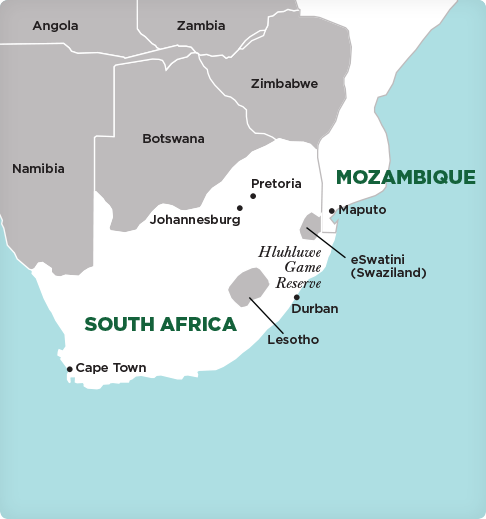
You will visit the Luthuli Museum, former home of Chief Albert Luthuli, the first Black Nobel Prize winner, and the home and ashram of Mahatma Gandhi, whose political consciousness was shaped in South Africa, to meet with his granddaughter. Learn about the role of NGOs in international relations on excursions to Cape Town and Maputo, Mozambique, which offered frontline state solidarity to South Africa during apartheid.
Highlights
- Explore career paths while engaging with diplomats and NGOs working in international relations to learn about South Africa’s transition from apartheid to democracy.
- Witness the mechanics and dismantling of South Africa’s apartheid system.
- Travel to Mozambique to learn about its role in the struggle against apartheid and the insurgency in the north of the country.
- Examine South-South relations and political and social developments through the lenses of various partnerships and governing bodies such as BRICS and the African Union.
Prerequisites
None.
Earn a Minor
Students studying on this SIT semester-length program can choose to simultaneously complete a minor, with no additional coursework or cost. At SIT, a minor is a minimum of 16 credits taken within a content area. This standout credential can help boost your future job or graduate school applications.
SIT's program in South Africa offers the choice to do a minor in international studies or Africana studies. You'll develop analytical skills in comparative politics, regional cooperation, and international governance while engaging with scholars, civil society organizations, and policy institutions in South Africa and on an excursion to Mozambique. Through coursework on post-colonial transitions and continental politics, field visits to historical sites and rural communities, and your Independent Study Project or internship with local organizations, you'll examine Global North/Global South partnerships, post-apartheid democratization, foreign policy, and contemporary political dynamics while analyzing how the Global South shapes international relations and challenges traditional power structures in the 21st century.
Find this program on social