SIT Study Abroad Logo

South Korea

Culture and Society

Explore how deep tradition and rapid change intersect in contemporary South Korea—through its society, arts, gender politics, and globe-spanning popular culture.

At a Glance

Credits

16

Prerequisites

None

Language of Study

Korean

Courses taught in

English

Dates

Aug 31 – Dec 13

Program Countries

South Korea

Program Excursion Countries

Japan

Program Base

Seoul

Visa

Required

Critical Global Issue of Study

Identity & Human Resilience

Overview

Why study abroad in South Korea?

This program immerses you in one of the world’s most dynamic societies, where centuries-old tradition and breakneck change collide in everyday life. All students take a shared core course, Korean Culture and Society: Continuity and Change, which builds a foundation for the program by exploring how historical legacies and forces like democratization, globalization, and rapid development shape contemporary Korean life. You will design your own focus, choosing two of four electives that approach contemporary Korea from distinct angles—through language, gender politics, arts and craft traditions, or globe-spanning popular culture (Hallyu). Whichever you choose, you will move well beyond the classroom to investigate how Koreans negotiate identity and belonging, through fieldwork, such as museum and workshop visits, oral histories, advocacy-organization case studies, and hands-on media analysis.

From the program’s base in vibrant Seoul, you will engage directly with the people, places, and institutions shaping contemporary Korea, guided by faculty and local experts. You will build a portfolio of reflections, fieldwork, and original analysis, honing the close-observation and evidence-based skills to make sense of a rapidly shifting society and to prepare for an international career. Excursions to Japan and the Demilitarized Zone (DMZ) place Korea in comparative and geopolitical perspective, illuminating colonial legacies, national division, and the politics of memory.

Highlights

  • Travel to Tokyo, Japan, to compare Korea and Japan and confront national division at the DMZ.
  • Customize your semester by choosing two of four electives across Korean language, gender, arts, and popular culture.
  • Learn through field-based assignments—oral histories, object biographies, advocacy case studies, and media deconstruction.
  • Engage Korea's living institutions, from craft villages and galleries to entertainment studios and fashion districts.
  • Build a multimedia portfolio and evidence-based final project—guided by faculty and local experts—that showcases your career-ready skills.

Prerequisites

None.

Earn a Minor

Students studying on this SIT semester-length program can choose to simultaneously complete a minor, with no additional coursework or cost. At SIT, a minor is a minimum of 16 credits taken within a content area. This standout credential can help boost your future job or graduate school applications.

SIT’s program in South Korea offers the choice to do a minor in Media Studies or East Asian studies. You’ll develop critical perspectives on Korean cultural production, global media circulation, and regional dynamics shaping the peninsula. Through coursework, field-based learning in Seoul, and your Independent Study Project or internship, you'll examine media industries, regional power relations, and transnational influences-graduating with the analytical tools, on-the-ground experience, and global perspective to thrive in careers spanning international affairs, media and communications, policy, and beyond.

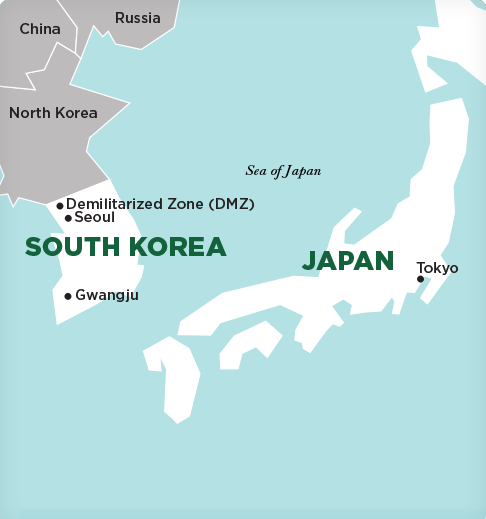
program map

Excursions

Demilitarized Zone (DMZ)

A guided excursion to the line dividing the two Koreas brings the program’s central themes into sharp focus. Visiting key sites along the world’s most heavily fortified frontier, students confront national division as a lived human reality rather than an abstraction. Standing where the peninsula has remained split since 1953, they explore how division shapes Korean identity, collective memory, and family separation—and how a resilient society makes meaning of a border that runs through its history.

Tokyo, Japan

This multi-day excursion places Korea in comparative perspective. Students observe Japanese society through the same thematic lenses developed across the semester and engage directly with the Korea–Japan relationship—colonial legacies, the politics of historical memory (comfort women, forced labor, the politics of apology), and contemporary tensions. The excursion turns abstract questions of continuity and change into a lived, comparative field experience.

Gwangju

This multi-day excursion anchors the Continuity and Change course in the city at the heart of Korea’s democratization story. Through the May 18th Democratic Uprising of 1980—its cemetery, archives, and memorial sites—students examine how civil society, resistance, and democratic memory are made and contested. The region’s distinct history reveals why the uprising happened here, turning abstract questions of continuity and change into lived field experience.

Please note that SIT will make every effort to maintain its programs as described. To respond to emergent situations, however, SIT may have to change or cancel programs.

Academics

Program Learning Outcomes

By the end of the program, you will be able to:

  • Analyze how historical legacies-including Confucian values, colonialism, and national division continue to shape social institutions and everyday life in contemporary South Korea.
  • Evaluate the social consequences of rapid transformation, examining how democratization, globalization, and economic development have reshaped family, education, class, gender, and generational relations.
  • Interpret sites of memory and identity—such as the DMZ and Gwangju’s May 18th memorials—to assess how Korean society constructs, contests, and commemorates its past.
  • Situate South Korea in regional and global perspective, drawing on comparative engagement with Japan to analyze colonial legacies, historical memory, and transnational cultural flows.
  • Produce evidence-based, original analysis of an aspect of Korean culture and society through an independent study project or internship, communicating findings to academic and public audiences.

Read more about Program Learning Outcomes.


Coursework

The following syllabi are representative of this program. Because courses develop and change over time to take advantage of dynamic learning opportunities, actual course content will vary from term to term.

The syllabi can be useful for students, faculty, and study abroad offices in assessing credit transfer. Read more about credit transfer.

Please expand the sections below to see detailed course information, including course codes, credits, overviews, and syllabi.


INTERNSHIPS

  • Arts, design, digital media, or cultural organizations and galleries in Seoul
  • Gender equality, LGBTQ+, or human rights advocacy organizations
  • Museums, craft studios, or cultural heritage institutions
  • International NGOs or cultural exchange programs
  • Start-ups, innovation, and entrepreneurship

Independent Study Project and internships are provided as examples and are not intended as a guarantee of subject matter approval or internship placement.


Gender & Society in South Korea

Gender & Society in South Korea – syllabus
(ASIA3030 / 3 credits)

This course examines how gender roles, identities, and representations shape everyday life in South Korea and how they have evolved amid rapid change. We will trace the legacies of Confucian patriarchy and industrial modernity alongside contemporary movements for gender equality and LGBTQ+ visibility, exploring intersections of gender, labor, family, and media through feminist activism, changing masculinities, and generational debate. Special attention is given to the K-Beauty and fashion industries as sites where gender ideals are constructed, contested, and globalized. Field visits to advocacy organizations, cultural institutions, and creative industries provide firsthand perspectives on how gender is negotiated, performed, and redefined.

Korean Arts: Historical & Contemporary Practices

Korean Arts: Historical & Contemporary Practices – syllabus
(ASIA3010 / 3 credits)

This course explores the traditions and contemporary expressions of fine arts and crafts in Korea, from classical court painting and ceramics to applied arts, modern design, and “K-Art.” Students analyze how artistic forms reflect cultural values, social change, and historical context, with attention to craftsmanship, symbolism, and aesthetic philosophies rooted in Confucianism, Buddhism, and shamanism. The course considers the revitalization of traditional crafts—pottery, lacquerware, hanbok, hanji, and calligraphy—alongside their reinvention in modern creative industries. Field visits to museums, galleries, workshops, and craft villages give students firsthand experience of Korea’s artistic legacy and its ongoing transformation.

Korean Popular Culture & Media

Korean Popular Culture & Media – syllabus
(ASIA3020 / 3 credits)

This course examines Korean popular culture and media as lenses into society, identity, and everyday life. We will analyze how K-pop, K-dramas, cinema, comics (manhwa), and webtoons represent gender, class, family, and generational change, and how these forms both reflect and shape Korean values. The course places K-culture in critical perspective—the global commodification of culture, the politics of representation, the pressures of the idol system, and the tensions between cultural pride and soft-power projection. Field visits to cultural institutions, entertainment-industry sites, and the DMZ provide firsthand perspectives on the lived and contested meanings of K-culture.

Korean

Beginning Korean – syllabus
(KORE1003-1503 / 3 credits)

This course includes an introduction to Korean, both spoken language and the written Hangul script. You will learn grammatical rules, vocabulary, structure, and methods of forming sentences. You will use Korean to express yourself in daily life, and to develop a deeper understanding of Korean culture through different applications of the language.

Intermediate Korean – syllabus
(KORE2003-2503 / 3 credits)

This course helps you improve intermediate skills in speaking, reading, writing, and listening. Continue to learn grammatical rules, vocabulary, structure, and methods of forming sentences. You will use Korean to express yourself in daily life, and to develop a deeper understanding of Korean culture through different applications of the language.

Social Science Methods and Ethics in Global Contexts OR Global Organizational Culture and Ethics

Choose one of the following two courses:

Social Science Methods and Ethics in Global Contexts – syllabus
(RSCH3500 / 3 credits)

This course is designed to introduce you to the methodological tools deployed by social scientists to conduct empirically grounded and theoretically engaged research. The course will cover the basic elements of research design, the role of theory in empirical research, and the ethics for social scientific research, with particular attention to the complex ethical considerations that arise when conducting research in international and cross-cultural contexts. You will gain hands-on experience with both basic quantitative and qualitative methods, with the flexibility to emphasize your preferred methodological approach in their your final work. Using this project-based approach, the course will prepare you to design and execute social science research projects while developing competency across methodological traditions.

OR

Global Organizational Culture and Ethics – syllabus
(GOCE3500 / 3 credits)

This course equips you to engage meaningfully and ethically in internship experiences across diverse sociopolitical, cultural, environmental, and global contexts. Using a critical, practice-based approach, you will examine the nature and purpose of internships as transformative experiential learning opportunities that connect to the program’s theme. Emphasis is placed on navigating workplace and organizational cultures, reflecting on identity and positionality in professional settings, and applying ethical principles to working globally with communities, individuals, and environments—particularly in collaboration with vulnerable populations and in sensitive ecological or habitat settings.

Independent Study Project OR Internship

In addition to taking the above courses, students will also need to enroll in one of the following two courses:

Independent Study Project – syllabus
(ISPR300 / 4 credits)

The Independent Study Project (ISP) offers you the opportunity to undertake an in-depth, analytical, and individualized approach to the independent study of an aspect of culture and socio-economic development or human-environment interaction that you find of academic interest. The ISP provides you with a hands-on research experience and the chance to interact with local experts and investigate a topic in which you are interested. The ISP process challenges you to take responsibility for developing learning goals and outcomes, remain focused in your attention to details, analyze your pre-conceptions and methodological approaches towards interacting with people and the environment, exercise critical thinking and caution in the interpretation of your results, and learn from successes as well as setbacks.

OR

Internship and Seminar – syllabus
(ITRN300 / 4 credits)

This seminar consists of a four-week internship with a local community organization, research organization, local or international NGO. The aim of the internship is to enable you to gain valuable work experience and to enhance their skills in an international work environment. You will complete an internship and submit a paper in which you process your learning experience on the job, analyze an issue important to the organization, and/or design a socially responsible solution to a problem identified by the organization.

Housing

Seoul

You will live in a student residence or apartment in Seoul. Residences typically include kitchen facilities, a washing machine, and Wi-Fi. Rooms may be shared, depending on availability.

Please note that specific housing locations and amenities are subject to change.

Discover the Possibilities

  • Cost & Scholarships

    SIT Study Abroad is committed to ensuring that international education is within reach for all students. We believe in the transformative power of immersive, intercultural experiences and are dedicated to supporting students in their educational journey.

    See All Costs
  • HEALTH, SAFETY &
    ACCESS

    A critical step in preparing for your study abroad program is planning how you will maintain your health and wellbeing. Please review the following information carefully and contact [email protected] with any questions or concerns.

    Learn More
  • Visa
    Requirements

    Students are required to obtain a visa for this program. Your admissions officer will provide you further guidance on the process and support documents. Please do not apply without instructions from your admissions officer.