SIT Study Abroad Logo

Switzerland

Choose Your Track—Wildlife, Food Systems, Cities OR French Culture

For greater flexibility in your study abroad experience, this program offers tracks to individualize your studies: wildlife, food systems, cities, or French culture.

At a Glance

Credits

16

Prerequisites

None

Language of Study

French

Courses taught in

English, French

Dates

Aug 31 – Dec 13

Program Countries

Switzerland

Program Excursion Countries

Austria

Program Base

Geneva

Visa

Required

Critical Global Issue of Study

Students may focus on any critical global issue, depending on their chosen track.

Overview

Why study abroad in Switzerland?

As a global hub, Switzerland offers a unique study abroad experience as you’ll immerse yourself in a highly international setting while exploring breathtaking natural landscapes and vibrant urban centers at the heart of Europe. By enrolling in this program, you’ll have the opportunity to select a specialized track that builds on shared foundational learning through the core Future of Europe course. Track options for this program include: wildlife, food systems, cities, or French culture. Your coursework will be enhanced with field visits, community engagement, and local guest lecturers. All students complete independent research or internships projects that connect their area of study to real-world challenges facing Switzerland. An excursion to Vienna will help expand your perspective about the broader European landscape.

Receive up to $1,000 in flight credits when you join this new program! Learn more HERE

Highlights

  • Choose from four specialized tracks: wildlife, food systems, cities, or French culture.
  • Engage with your full cohort through the Future of Europe course.
  • Meet directly with local politicians, scholars, and community organizations navigating the territorial, environmental, and cultural landscape.
  • Travel to Vienna to gain a broader European perspective.
  • Conduct independent research or an internship while deepening your expertise in your chosen track.

Prerequisites

None. Students choosing the French Studies track must have intermediate-level French proficiency.

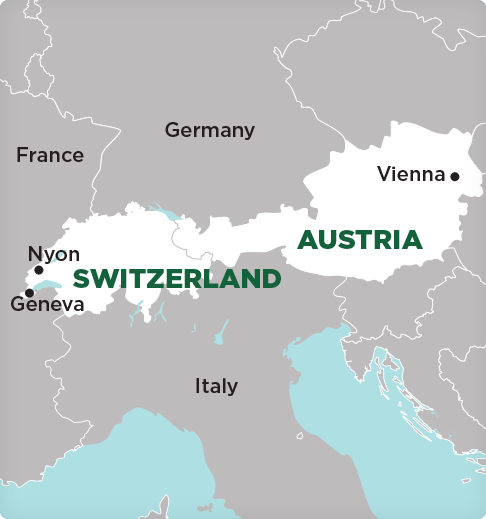
program map

Excursions

Vienna

Embark on a week-long excursion to Vienna, immersing yourselves in Europe’s imperial past and its vibrant present as a global diplomatic hub. This unique journey will offer unparalleled insights into the continent’s evolving geopolitical landscape, its rich cultural tapestry, and the international institutions actively shaping the future of Europe.

Please note that SIT will make every effort to maintain its programs as described. To respond to emergent situations, however, SIT may have to change or cancel programs.

Academics

Program Learning Outcomes

Upon completion of the program, students will be able to:

  • Articulate Switzerland’s unique historical and contemporary perspectives through the broader lens of the European political, economic, and cultural landscape.
  • Analyze contemporary Swiss challenges through your chosen track (biodiversity and conservation; food studies; European cultural studies; and French studies), demonstrating how disciplinary perspectives contribute to understanding Swiss society in the broader European context.
  • Synthesize learning acquired on the program in the form of an Independent Study Project or internship experience that connects theoretical frameworks to real-world issues in Spanish society.
  • Apply effective networking skills in the international community of Geneva.
  • Demonstrate personal autonomy, critical thinking, and problem-solving capacities.
  • Enhance communicative proficiency in French and demonstrate cross-cultural competence in engaging with diverse French communities and perspectives.

Read more about Program Learning Outcomes.


Coursework

The following syllabi are representative of this program. Because courses develop and change over time to take advantage of dynamic learning opportunities, actual course content will vary from term to term.

The syllabi can be useful for students, faculty, and study abroad offices in assessing credit transfer. Read more about credit transfer.

Please expand the sections below to see detailed course information, including course codes, credits, overviews, and syllabi.

Future of Europe (All Students)

The Future of Europe – syllabus
(EURO-3053 / 3 credits)

This course focuses on the key questions that shape Europe’s future, including the continued existence of the European Union, the division and balance of power sharing between the EU and its member nations, the threat of member nation “exits,” the pitched battle over migration policy and politics, and Europe’s approach to climate governance. In order for students to engage meaningfully with these questions, the course will begin with an in-depth overview of the institutions, laws, and policies that govern the European Union, while tracing the tension between these and the national sovereignty of EU member states.

Choose Your Track: Elective Options

Elective Options, choose 1 of 4:

  • Human-Wildlife Interactions in Europe (Wildlife Track)
  • Food and European Society: From Farm to Table (Food Systems Track)
  • City Life: Representations & Realities (Cities Track)
  • Contemporary French Literature & Cinema (French Culture Track)

Human-Wildlife Interactions in Europe (Wildlife Track) – syllabus
(IDST-3063 / 3 credits)

This course investigates the evolving relationship between humans and wildlife in Europe’s diverse ecosystems, with a focus on regionally grounded challenges and continental conservation frameworks. Using field-based learning, students analyze how land use, urbanization, agriculture, and climate change influence biodiversity. Emphasis is placed on habitat fragmentation, species recovery, cultural and ethical dimensions of conservation, and broader, regional commitments to biodiversity protection and ecosystem restoration.

Food and European Society: From Farm to Table (Food Systems Track) – syllabus
(SDIS-3060 / 3 credits)

This interdisciplinary course explores the intricate and dynamic relationship between food and society across Europe. Moving beyond mere sustenance, this course delves into how food production, distribution, consumption, and representation have shaped European cultures, economies, social structures, and identities from historical roots to contemporary settings. Through a “farm to table” lens we examine the journey of food – from agricultural practices and landscapes to culinary traditions, market systems, and the diverse ways Europeans eat and think about what they eat.

City Life: Representations & Realities (Cities Track) – syllabus
(URST-3060 / 3 credits)

This course examines how representations of European cities and their cultural institutions popularized across the mediascape perpetuate dominant discourses of inclusion and exclusion in urban life. By contrasting idealized and commercialized narratives with the lived experiences of residents in the center and on the outskirts, students will explore how perceptions of the city and its denizens are constructed and challenged.

Contemporary French Literature & Cinema (French Culture Track) – syllabus
(Taught in French; intermediate/advanced proficiency required)
(ARTS-3060 / 3 credits)

This course offers an intensive exploration of French and Francophone literature and cinema from the post-World War II era to the present day, with a particular emphasis on voices and themes relevant to contemporary France and the Francophone world, including a dedicated focus on Swiss-French contributions. Through critical engagement with key literary texts and films, students will analyze how artists have grappled with issues of identity, memory, social change, globalization, migration, gender, and the human condition. This course is taught in French.

French: Beginner, Intermediate, or Advanced

French: Beginner, Intermediate, or Advanced
3 credits

Beginning French I – syllabus
(FREN1003 / 3 credits)

Beginning French II- syllabus
(FREN1503 / 3 credits)

Intermediate French I – syllabus
(FREN2003 / 3 credits)

Intermediate French II – syllabus
(FREN2503 / 3 credits)

Advanced French – syllabus
(FREN3003 / 3 credits)

Emphasis on speaking and comprehension skills through classroom and field instruction. Students are placed in intensive beginning, intermediate, or advanced classes based on in-country evaluation, including oral proficiency testing.

Please note that students can choose to take another course from the tracks offered instead of French, if desired.

Research Methods and Ethics

Research Methods and Ethics
3 credits

The Research Methods and Ethics seminar provides the theoretical, conceptual, and practical tools for conducting field research in a new cultural environment. The main emphasis of the seminar is on the development of interactive research skills involving the collection of primary data.

Independent Study Project or Internship

Independent Study Project or Internship and Seminar
4 credits

In addition to taking the above courses, students will also need to enroll in one of the following two courses:

Independent Study Project – syllabus
(ISPR-3000 / 4 credits)

The Independent Study Project (ISP) is a self-designed research project offering students the opportunity to undertake a personally significant and independent investigation, which highlights the regional and cultural reality that can only be encountered during a study abroad experience. The ISP is the academic component in which the student most directly applies the concepts, skills, tools, and techniques of experience-based learning articulated through the Research Methods and Ethics (RME) course and the thematic courses, while enabling students to further integrate their language skills and the contacts they have developed at the level of the international community in Geneva, as well as the regional Swiss/European levels.

OR

Internship and Seminar – syllabus
(ITRN-3000 / 4 credits)

This seminar consists of a four-week internship with a local community organization, research organization, business, government agency, or international NGO. The aim of an internship is to enable students to gain valuable experience and enhance their skills in a career field/professional environment related to the core program themes.

Housing

Nyon Homestay

You’ll live with a Swiss or international family outside Nyon. During the homestay, you may enjoy outings with your host families, such as skiing, tennis, swimming and/or hiking. Cultural events include music festivals, art exhibitions, museums, and theaters.

Homestay families are usually middle class and reflect the cultural diversity of Switzerland; many speak more than one language (often German, English, and/or Italian) in addition to French. Living with your homestay family will help you improve your French language skills and gain insight into the traditional values of Switzerland, such as tolerance, federalism, neutrality, and direct democracy.

Nyon is located on the shores of Lake Geneva, about 15 miles from downtown Geneva, and most homestay families live within the surrounding area. You will commute to classes and program activities in Nyon and Geneva just like the locals, using the region’s excellent public transportation system.

You will continue to live with your homestay family during the ISP period.

Discover the Possibilities

  • Cost & Scholarships

    SIT Study Abroad is committed to ensuring that international education is within reach for all students. We believe in the transformative power of immersive, intercultural experiences and are dedicated to supporting students in their educational journey.

    See All Costs
  • HEALTH, ACCESS &
    IDENTITY

    A critical step in preparing for your study abroad program is planning how you will maintain your health and wellbeing. Please review the following information carefully and contact [email protected] with any questions or concerns.

    Learn More
  • Visa
    Requirements

    Students are required to obtain a visa for this program. Your admissions officer will provide you further guidance on the process and support documents. Please do not apply without instructions from your admissions officer.