SIT Study Abroad Logo

South Africa

International Relations in the Global South

Explore non-western perspectives on South-South and international relations through lectures, visits, and internships involving diplomats, activists, and intellectuals in South Africa and Mozambique.

At a Glance

Credits

16

Prerequisites

None

Language of Study

isiZulu

Courses taught in

English

Dates

Aug 28 – Dec 6

Program Countries

South Africa

Program Excursion Countries

Mozambique

Program Base

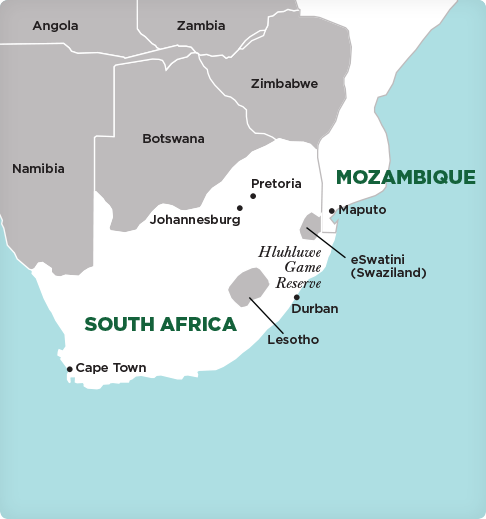
Durban

Visa

Required

Critical Global Issue of Study

Geopolitics & Power

Development & Inequality

Overview

Why study abroad in South Africa and Mozambique?

This program offers an opportunity to learn non-western perspectives in the fields of South-South and international relations and to examine broad policy questions in sub-Saharan Africa through the lenses of youth employment, conflict, and poverty. Starting in Mozambique before traveling to Durban, South Africa, you will get an introduction to South African politics. This sets the groundwork for the program’s focus on international relations and foreign policy, allowing you to engage in major contemporary debates surrounding international affairs in the Global South. The program also captures the evolving contours of the relationship between the Global South and the Global North.

We examine the African Union and other continental influencers including international organizations and non-state actors, and we look at how BRICS (Brazil, Russia, India, China, and South Africa) has emerged as an alternative power block on the global political stage. Central to the program is the opportunity to intern at an internationally acclaimed NGO such as the Africa Centre for the Constructive Resolution of Disputes (ACCORD), the Institute for Global Dialogue (IGD), the Center for Applied Legal Studies (CALS), the South African Institute of International Affairs (SAIIA), or the Centre for African Diplomacy and Leadership (CADL).

You will visit the Luthuli Museum, former home of Chief Albert Luthuli, the first Black Nobel Prize winner, and the home and ashram of Mahatma Gandhi, whose political consciousness was shaped in South Africa, to meet with his granddaughter. Learn about the role of NGOs in international relations on excursions to Cape Town and Maputo, Mozambique, which offered frontline state solidarity to South Africa during apartheid. The program concludes in Cape Town, where you will be able to visit a range of museums, hike Table Mountain, and enjoy South Africa’s picturesque coastline.

Highlights

  • Learn about Mozambique's role in the struggle against apartheid and the insurgency in the north of the country.
  • Explore career paths while engaging with diplomats and NGOs working in international relations.
  • Witness the mechanics and dismantling of South Africa’s apartheid system and learn about South Africa’s transition from apartheid to democracy.
  • Examine South-South relations and political and social developments through the lenses of various partnerships and governing bodies such as BRICS and the African Union.

Prerequisites

None.

Find this program on social

program map

Excursions

Mozambique

The program begins in Mozambique. You will study the shared histories of South Africa and Mozambique and the key collaborative role played by Mozambique’s ruling party, Frelimo, in the liberation struggle against apartheidThis framing explains a key example of historical and contemporary South-South relations and how Mozambique rose to the political occasion for South Africa following Mozambique’s own hard-fought independence from Portugal in the 1970s. Meet with officials from the Foreign Affairs ministry and learn from activists such as Former Constitutional Court Judge Albie Sachs.

In and Around Durban

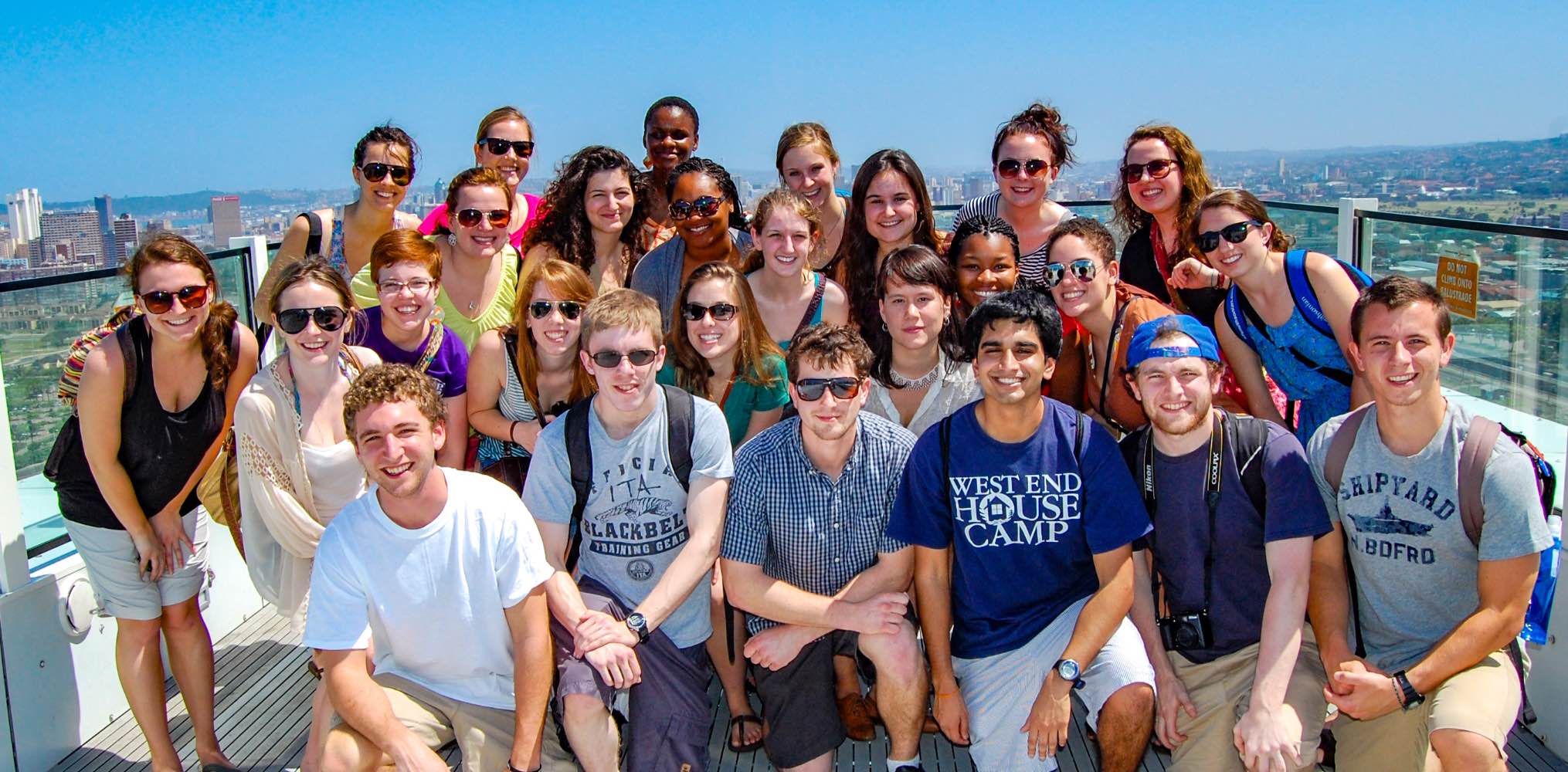
Your base for the program will be in Durban, one of South Africa’s most cosmopolitan cities with a rich fusion of African, western, and Asian influences. You’ll visit residents of an informal shack dwellers settlement; an African traders’ market; an ecotourism project; a center for jazz and popular music; and local museums like the KwaMuhle Museum, where you will learn about the history of apartheid. In addition, you will learn more about Mahatma Gandhi from his granddaughter, Ela Gandhi, and visit the Luthuli Museum to learn about Albert Luthuli, an anti-apartheid leader and the first African to be awarded the Nobel Peace Prize.

Rural KwaZulu-Natal

You will live with families in the Amacambini Reserve for a short rural homestay. During this excursion, you will engage in a research project to understand rural economies, development, and land usage.

Hluhluwe-iMfolozi Game Reserve

Visit the Hluhluwe-iMfolozi Game Reserve, one of the largest and oldest game reserves in South Africa, where you will have the chance to spot the “Big Five” (lion, leopard, buffalo, elephant, and black and white rhino), as well as giraffes, warthogs, and zebras.

Cape Town

During the evaluation period, the program travels to Cape Town, where you will typically visit Robben Island, site of the prison that held late South African President Nelson Mandela for 18 years and many other political activists. It is also a UNESCO World Heritage Site. In addition, you will trek or ride up the scenic cliffs of Table Mountain, part of the coastal Table Mountain National Park. You may have some time to explore the city and Bo-Kaap and the Iziko Museums on your own.

Please note that SIT will make every effort to maintain its programs as described. To respond to emergent situations, however, SIT may have to change or cancel programs.

Academics

Program Learning Outcomes

Upon successful completion of the program, students will be able to: 

  • Demonstrate knowledge of major theories, paradigms, and perspectives in the field of international relations and how they relate to South Africa’s trajectory.
  • Interpret South Africa’s transition from apartheid to democracy through discussions with key South African diplomats.
  • Use the lens of South African diplomacy to analyze the positions, goals, and relationships among various continental and international alliances, from the African Union, to BRICS (Brazil, Russia, India, China, South Africa).
  • Apply appropriate ethical and intercultural skills while doing an internship or Independent Study Project in the context of South Africa
  • Carry on casual conversations in isiZulu and discuss the role of language in social cohesion initiatives in South Africa.

Read more about Program Learning Outcomes.


Coursework

Access virtual library guide.

The following syllabi are representative of this program. Because courses develop and change over time to take advantage of dynamic learning opportunities, actual course content will vary from term to term.

The syllabi can be useful for students, faculty, and study abroad offices in assessing credit transfer. Read more about credit transfer.

Please expand the sections below to see detailed course information, including course codes, credits, overviews, and syllabi.


Key Topics

  • Africa and the International Order
  • bullet list icon
  • BRICS Challenges and Accommodations with Global Power Relations
  • bullet list icon
  • Examining SA’s foreign policy agenda
  • bullet list icon
  • SA/US relations and the changing global order

International Relations in the Global South

International Relations in the Global South
(INTS3000 / 3 credits)

This interdisciplinary seminar begins with an introduction to South African politics and goes on to wade into the field of international relations and diplomacy, introducing students to dominant theoretical paradigms in international relations. The course will also explore major contemporary issues and border politics in the Southern African region.

Continental Geopolitics and South-South Relations

Continental Geopolitics and South-South Relations
(INTS3005 / 3 credits)

The course looks at the impact of poor governance on Africa’s development and will explore how geopolitics in Africa are characterized by cooperation and competition over natural resources, as well as a desire of African countries to forge stronger links with the world’s traditional and emerging superpowers.

A large part of the course looks at continental organizations such as the African Union, international organizations and non-state actors, and the roles played by African states in regional organizations. Students will also be introduced to the recent resurgence of South–South cooperation in international affairs, in the context of how BRICS (Brazil, Russia, India, China, and South Africa) has emerged as an alternative power block and moved to the center stage of world politics.

isiZulu

isiZulu – syllabus
(ZULU1003 / 3 credits)

Emphasis is on beginning speaking and comprehension skills through classroom instruction. The course aims to develop conversational abilities in isiZulu and provide greater insight into various aspects of Zulu culture through discussions and excursions.

Research Methods and Ethics

Research Methods and Ethics – syllabus
(ANTH3500 / 3 credits)

A course in the concepts of learning across cultures and from field experience. The seminar provides an introduction to an Independent Study Project or internship and related material, including cross-cultural adaptation and skills building; project selection and refinement; appropriate methodologies; field study ethics and the World Learning/SIT Human Subjects Review Policy; developing contacts and finding resources; developing skills in observation and interviewing; gathering, organizing, and communicating data; and maintaining a field journal.

Independent Study Project or Internship

In addition to taking the above courses, students will choose one of the following two tracks:

Internship
Internship & Seminar – syllabus
(ITRN3000 / 4 credits)

This course consists of a four-week internship with a national or international relations organization that is working on South-South relations, foreign policy or conflict resolution within the southern Africa context. The internship enables students to obtain skills and knowledge in methods, principles of, and obstacles to African development, continental solidarity, and peace within societies that have been highly polarized by racialized social welfare policies and racialized national politics, as was the case in South Africa for many decades.
Sample internships:

  • Assisting creative solutions to challenges posed by conflict at ACCORD (African Centre for the Constructive Resolution of Disputes), Africa’s largest conflict resolution NGO, specializing in conflict management, analysis, and prevention through mediation, negotiation, training, and research
  • Working with researchers advancing balanced, relevant and policy-oriented analysis, debate and documentation of SA and Africa’s global politics and diplomacy at the South African Institute for International Affairs
  • Supporting research, public education, and legislative initiatives at the Legal Resources Centre

OR

Independent Study Project
Independent Study Project – syllabus
(ISPR3000 / 4 credits)

Conducted in Durban or in another approved location appropriate to the project. Students may choose to complete either a research-based or practicum-based Independent Study Project, the former being a traditional research paper and the latter emerging from a practicum with an affiliated organization working in social and/or political transformation. Sample topic areas: border politics in the southern African region; peace and conflict in the SADC region; democracy as defined by South Africans; insurgency in Cabo Delgado; unconstitutional changes in government on the African continent; deglobalization and the rise and fall of the BRICS challenge to the West.

Sample ISP topic areas:

  • U.S./South Africa relations
  • Political risk analysis
  • International trade blocs and implications on Africa and South Africa
  • The African Continental Free Trade Agreement and implications on Africa and South Africa
  • China-Africa relations
  • The Belt and Road Initiative and implications of African foreign policy
  • Political violence in the SADC region

Browse this program’s Independent Study Projects and undergraduate research.

Housing

Durban Suburbs

Your first homestay experience will be in either Glenwood or Cato Manor with a swap halfway through this homestay period. Students will get a holistic experience of the types of living environments around the learning center.  

Prior to apartheid, Cato Manor was a multi-cultural location. The area underwent many demographic changes, giving it a very unique history. Through the practice of isiZulu, you will experience the richness of daily life in Cato Manor and gain insights into what life is like in a peri-urban suburb. Cato Manor is about eight kilometers from the SIT Learning Centre.  

Glenwood is a formerly white suburb at the foot of the University of KwaZulu-Natal, which has become more cosmopolitan through the emergence of the Black middle class. Socio-economic mobility has seen more isiZulu speakers buying properties in former white suburbs. You will experience quiet living with a family in a leafy suburb. Glenwood is about four kilometers from the SIT Learning Centre.

Amacambini

This is a rural homestay for three to four days in Amacambini, about 100 kilometers north of Durban. You will spend an additional night in a lodge to experience a game drive. Some homes may not have indoor plumbing or piped water.

Newlands

Live for nearly two weeks in Newlands, approximately 20 kilometers from Durban’s city center, with an Indian or Coloured family.

Excursion & Orientation Accommodations

During the final four weeks of the program, many students in Durban choose to stay in apartments. Other accommodations during the program may include hostels, private homes, or small hotels.

Career Paths

Recent positions held by alumni of this program include:

  • Researcher for the Special Rapporteur for Truth, Justice, Reparation, and Guarantees of Non-Recurrence at the United Nations Human Rights Council, Memphis, TN

  • Researcher at ACCORD (Africa Centre for the Constructive Resolution of Disputes), Durban, South Africa

  • Policy Specialist at the U.S. Department of State’s Bureau of Conflict and Stability, Washington, DC

  • Researcher at National Geographic, Washington, DC

  • Manager at Open Society Foundation, London, UK

Faculty & Staff

South Africa: International Relations in the Global South

Imraan Buccus, PhD bio link
Imraan Buccus, PhD
Academic Director
Nonceba Lushaba bio link
Nonceba Lushaba
Academic Coordinator
Shola Haricharan bio link
Shola Haricharan
Office Manager and Homestay Coordinator

Discover the Possibilities

  • Cost & Scholarships

    SIT Study Abroad is committed to ensuring that international education is within reach for all students. We believe in the transformative power of immersive, intercultural experiences and are dedicated to supporting students in their educational journey.

    See All Costs
  • HEALTH, SAFETY &
    ACCESS

    A critical step in preparing for your study abroad program is planning how you will maintain your health and wellbeing. Please review the following information carefully and contact [email protected] with any questions or concerns.

    Learn More
  • Visa
    Requirements

    Students are required to obtain a visa for this program. Your admissions officer will provide you further guidance on the process and support documents. Please do not apply without instructions from your admissions officer.

  • Follow us on Instagram!

    Come along as we explore social and political change in Durban and beyond!

    Instragram